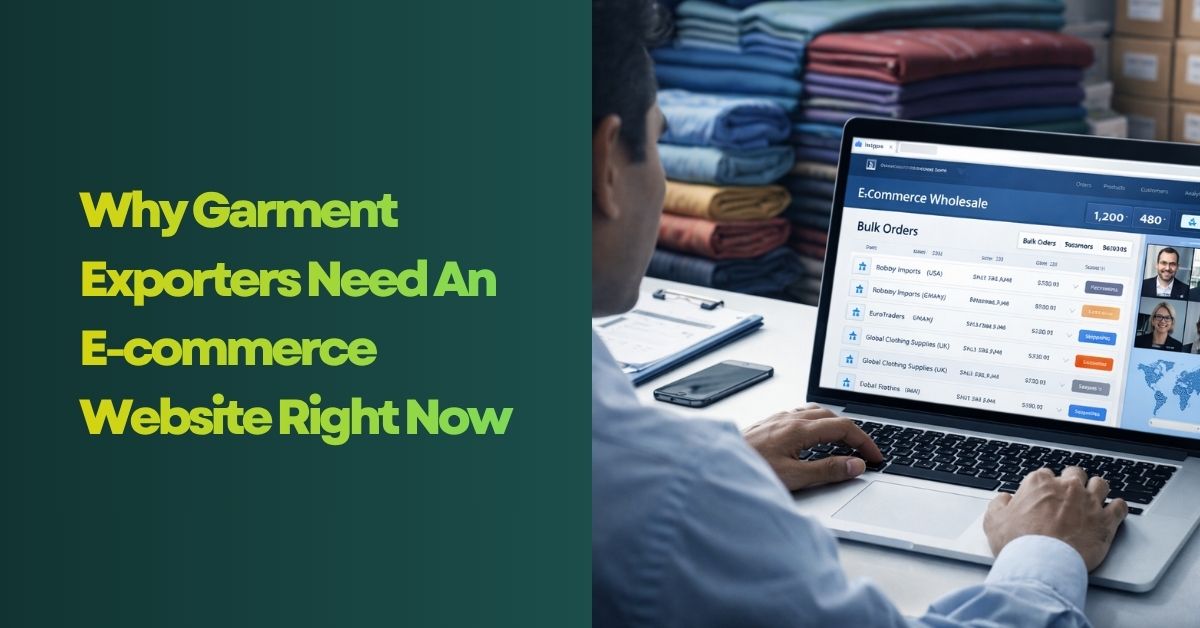
The knitwear capital of India is changing fast. Factories that once relied solely on trade fairs and middlemen are now losing orders to competitors who sell directly online — 24 hours a day, to buyers across 50 countries.
Tiruppur produces over 90% of India’s cotton knitwear exports and ships garments worth thousands of crores every year to buyers in Europe, the USA, and the Middle East. Yet a large number of manufacturers and exporters in the region still depend on WhatsApp forwards, trade directory listings, and word-of-mouth referrals to find new buyers.
In 2026, that approach is leaving enormous business on the table. International buyers no longer attend trade fairs to discover new suppliers — they search online. If your factory does not have a professional e-commerce or B2B website, you are simply not in the running.
90% – of India’s cotton knitwear comes from Tiruppur
65% – of global B2B buyers research suppliers online before contacting
3x – higher order value from direct online buyers vs middlemen
The old way vs the new way
For decades, garment exporters in Tiruppur built their business through personal networks, buying agents, and export houses. While those channels still matter, they come with serious limitations — heavy commissions, limited reach, and dependency on a handful of relationships.
Old method — without a website
- Rely on export agents who take 10–15% commission
- Limited to buyers who visit trade fairs
- No control over pricing or brand positioning
- New buyer discovery takes months
- Invisible to Google searches by international buyers
- Lose orders to competitors with a web presence
New method — with an e-commerce website
- Sell directly to buyers — zero commission
- Reach buyers in 50+ countries around the clock
- Full control over catalogue, pricing, and MOQ
- New buyers find you on Google within weeks
- Build your own brand — not just your agent’s
- Accept bulk enquiries and payments online
5 reasons Tiruppur exporters need an e-commerce website now
1. International buyers search online first
A buyer in Germany or the USA looking for a T-shirt manufacturer will search “wholesale knitwear manufacturer India” or “cotton garment exporter Tiruppur” on Google. If your business does not appear in those results, that buyer will contact your competitor. An e-commerce website with proper SEO puts you directly in front of these buyers at the exact moment they are ready to place an order.
2. Cut out the middleman — keep the full margin
Buying agents and export houses typically charge 10 to 15 percent commission on every order. On a shipment worth Rs. 10 lakhs, that is Rs. 1 to 1.5 lakhs gone before you see a rupee. A B2B e-commerce website lets you connect directly with buyers and keep that margin entirely for your business. Most exporters recover the cost of their website within the first direct order they receive online.
3. Your product catalogue works for you 24/7
Trade fairs happen a few times a year. Your website never closes. A well-designed garment e-commerce site showcases your full product range — fabric types, GSM, colour options, MOQ, and delivery timelines — so buyers can evaluate your factory at 2 AM on a Sunday from anywhere in the world. When they are ready to enquire, your WhatsApp button or enquiry form is right there.
4.Build a brand, not just a factory
The most successful garment businesses in Tiruppur are no longer just manufacturers — they are brands. Companies that have invested in professional websites with strong brand identities command higher prices, attract premium buyers, and are less vulnerable to price competition. Your website is where your brand story, certifications (GOTS, OCS, BCI), and sustainability practices can be communicated to buyers who specifically seek ethical suppliers.
5.Compete with larger exporters on equal footing
A small or mid-sized factory in Tiruppur with a professional website can appear just as credible — and rank just as high on Google — as a large exporter with hundreds of employees. A well-built website levels the playing field completely. Your website does not reveal the size of your factory; it reveals the quality of your products and the professionalism of your business.
What a garment exporter’s website must include
- Professional product catalogue with fabric details, GSM, colours, and minimum order quantity (MOQ)
- Factory profile page with photos of production floor, machinery, and team
- Export certifications display — GOTS, OCS, BCI, ISO, and audit reports
- Bulk enquiry form with fields for product type, quantity, delivery country, and timeline
- WhatsApp chat button for instant communication with international buyers
- Multi-currency pricing display for buyers from the USA, UK, Europe, and the Middle East
- SEO-optimised pages targeting keywords like “knitwear manufacturer India” and “garment exporter Tiruppur”
- Mobile-responsive design for buyers browsing on phones and tablets globally
- Sample request workflow so buyers can order fabric swatches or product samples directly online
The Tiruppur opportunity — and who is capturing it
The knitwear belt stretching from Tiruppur through Erode, Karur, and Coimbatore represents one of the largest garment manufacturing clusters in the world. Buyers from over 60 countries source from this region every year. Yet the digital presence of most factories in this belt remains surprisingly weak.
The exporters who are winning in 2026 are not necessarily the largest factories — they are the ones who are most visible online. A mid-sized unit in Tiruppur with a well-optimised e-commerce website is currently receiving direct enquiries from retail brands in Sweden, boutique buyers in the UAE, and wholesale distributors in Canada — all without a single buying agent involved.
One Tiruppur-based knitwear exporter received 12 new buyer enquiries in the first 60 days after launching their B2B e-commerce website — including two orders from European sustainable fashion brands worth over Rs. 18 lakhs combined.
What about selling on Amazon or Flipkart instead?
Marketplace platforms like Amazon, Flipkart, and IndiaMart have their place — but they come with significant limitations for garment exporters. You pay commission on every sale, you have no control over your brand presentation, and you are always competing on price with hundreds of similar sellers.
Your own e-commerce website and a marketplace listing are not mutually exclusive — but your website must be the foundation. It is where your brand lives, where serious bulk buyers land, and where you collect customer data that belongs entirely to you.
Think of your website as your flagship showroom. Marketplaces are just additional distribution channels that drive traffic back to it.
How Bitzburg helps garment exporters go online
Bitzburg is a Nagercoil-based web design company with deep experience building B2B and e-commerce websites for Tamil Nadu’s manufacturing and export businesses. We understand the specific needs of garment exporters — bulk ordering workflows, product catalogue management, multilingual buyer communication, and international SEO.
We build fast, mobile-first, SEO-optimised websites that are designed not just to look good — but to generate real buyer enquiries from day one.
The garment industry in Tiruppur has survived and thrived through decades of change — from manual looms to automated knitting machines, from domestic trade to global exports. The shift to e-commerce is simply the next evolution. The factories that make this transition now will build stronger buyer relationships, higher margins, and a more resilient business for the next decade.
Your products are world-class. Now it is time your website said the same.
Bitzburg builds B2B and e-commerce websites for garment exporters and manufacturers across Tamil Nadu. Based in Nagercoil — serving businesses nationwide.