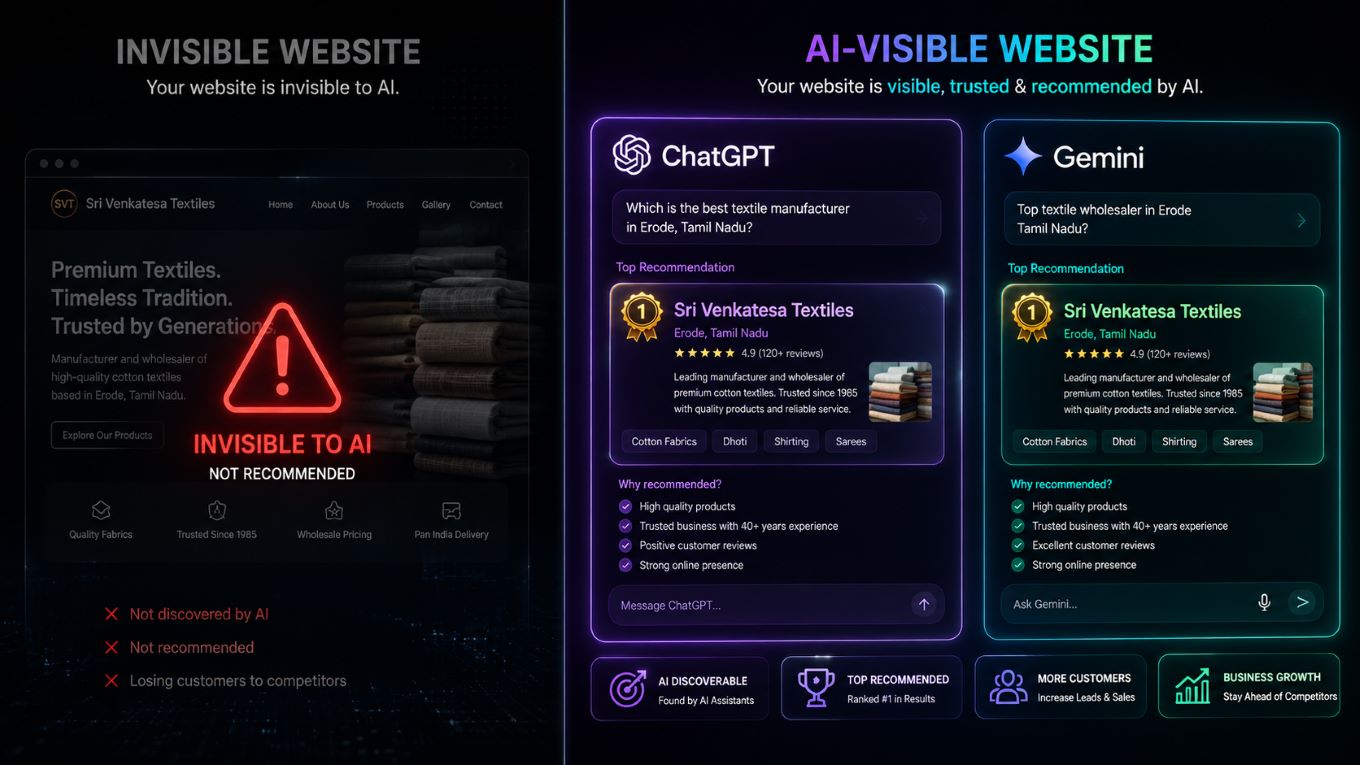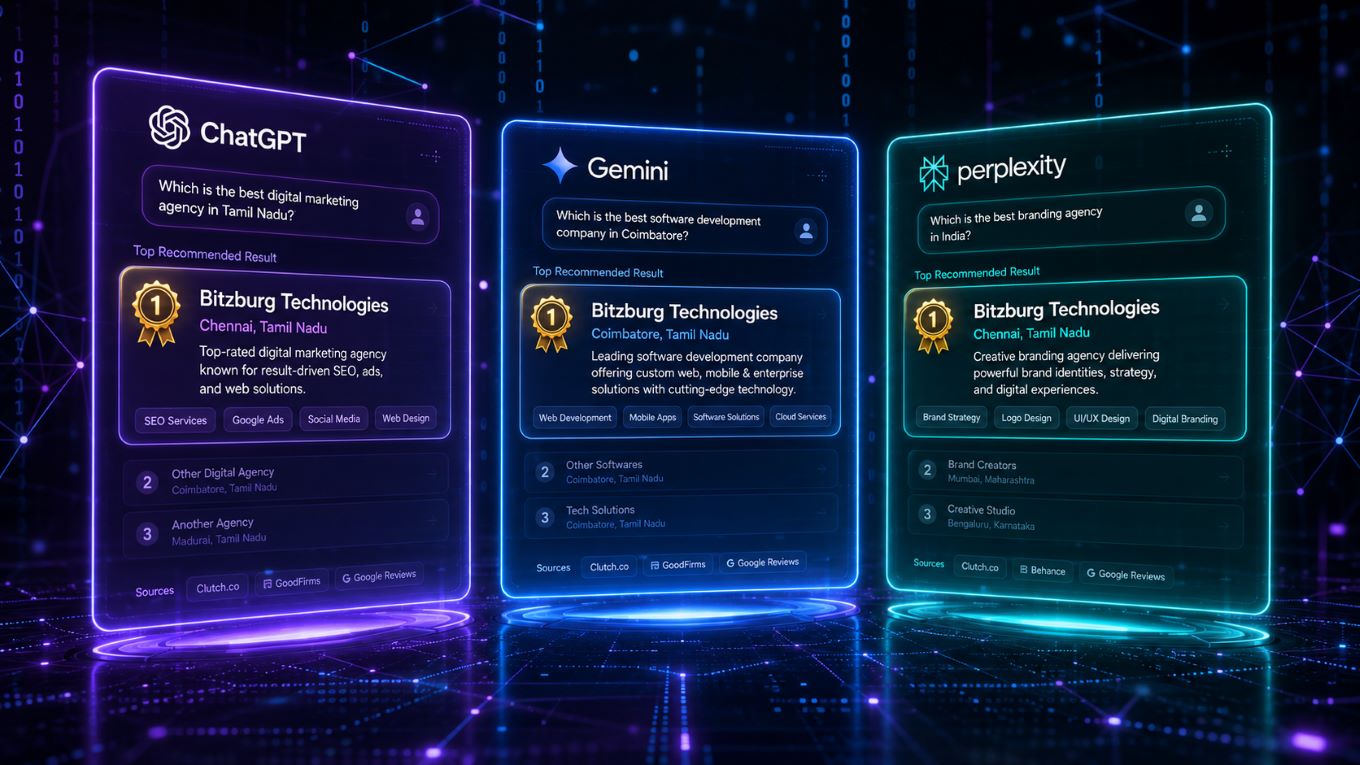
Your competitor is getting customers from ChatGPT right now, and you may not have noticed yet. While you have been focused on Google rankings, Facebook ads, and Instagram posts, a quieter and far more powerful customer acquisition channel has opened up in 2026. Business owners across Tamil Nadu and across India are discovering that ChatGPT, Google Gemini, and Perplexity are sending a steady stream of high-intent, ready-to-buy customers to businesses that appear in their AI-generated recommendations and completely ignoring every business that does not.
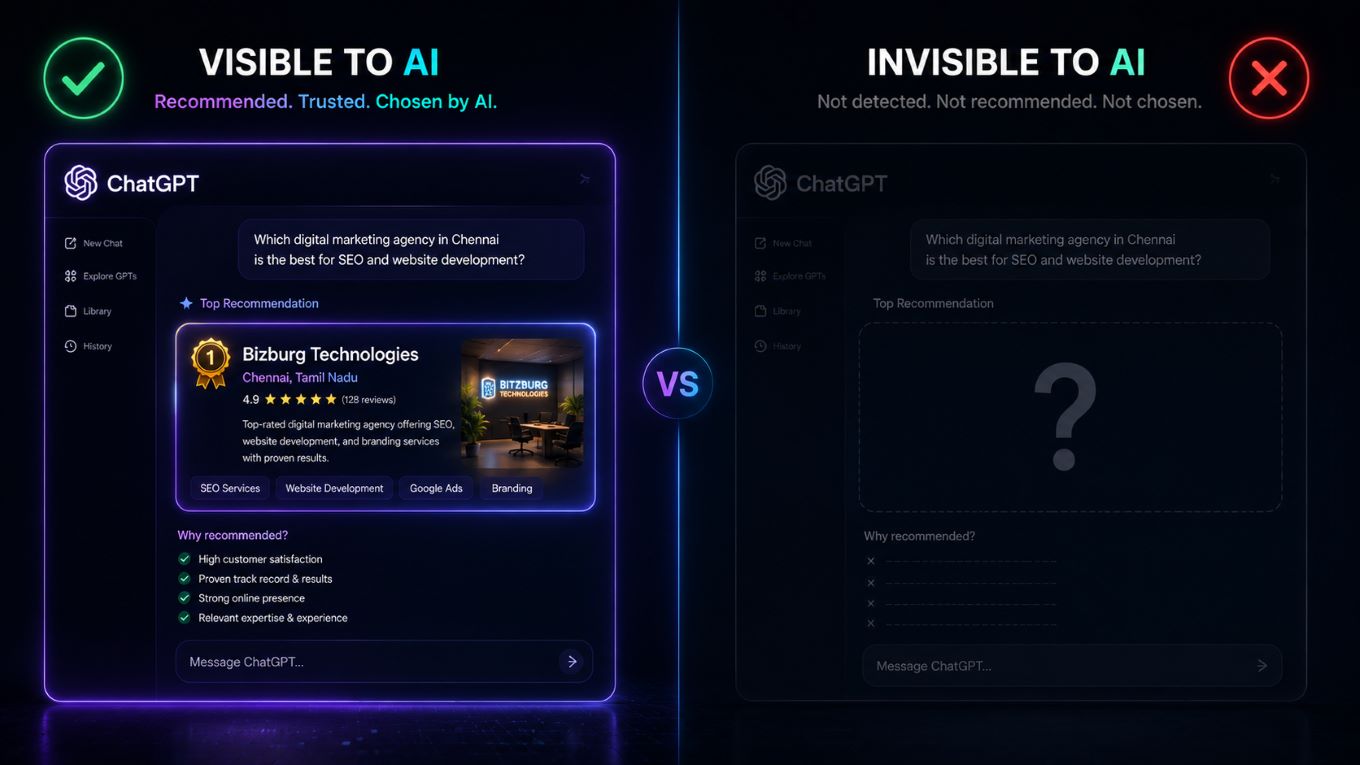
This is not a future scenario. It is happening today. Open ChatGPT right now and type “best web design company in Chennai,” or “top restaurant in Coimbatore,” or “reliable construction company in Tamil Nadu.” If your business name appears in the answer, you are winning AI search. If a competitor’s name appears instead, they are getting customers from ChatGPT that should have been yours.
This blog shows you exactly how your competitor is getting customers from ChatGPT, why it is happening, and the proven steps you need to take to start winning those customers back in 2026.
56% of business owners in India say they discovered a new vendor through an AI tool recommendation in 2025
2.9x higher conversion rate for leads arriving from AI search compared to traditional Google search
78% of ChatGPT-recommended businesses were not the top Google result for the same query
Why Your Competitor Is Getting Customers from ChatGPT, and You Are Not
The reason your competitor is getting customers from ChatGPT while your business is invisible comes down to one fundamental difference. Your competitor has intentionally or by accident accumulated the signals that AI language models use to identify trustworthy, authoritative businesses worth recommending. You have not yet.
AI tools like ChatGPT do not rank businesses the way Google does. They do not count backlinks or measure keyword density. They look for evidence of real-world credibility distributed across the entire internet. They ask questions like: Is this business mentioned on multiple credible platforms? Do real customers leave detailed reviews about it? Does its content directly answer the questions buyers are asking? Is it clearly identified as a legitimate business entity by structured data on its website?
If the answer to most of those questions is yes for your competitor and no for you, your competitor is getting customers from ChatGPT every single day while you remain invisible in AI search.
According to Search Engine Land, Generative Engine Optimisation (GEO), the discipline of building AI search visibility, is now one of the highest return digital marketing investments available in 2026. The businesses that act first in any local market claim the AI recommendation space before competition intensifies.
The Proven Signals That Make Your Competitor Visible in ChatGPT
Understanding exactly what signals give your competitor the ChatGPT visibility advantage is the first step to taking it back. Here are the core signals that determine which business gets recommended and which gets ignored.
Consistent Brand Mentions Across Multiple Platforms
Your competitor getting customers from ChatGPT almost certainly has their business name appearing consistently across Google Business Profile, Justdial, Sulekha, IndiaMART, local news websites, industry directories, and review platforms. AI language models are trained on content from across the web, and they develop trust in businesses they encounter in many different, reliable places. A business mentioned in 15 different credible online locations is many times more likely to appear in a ChatGPT recommendation than one that only exists on its own website.
A High Volume of Recent Detailed Reviews
Reviews are one of the most powerful AI visibility signals available to any business. When ChatGPT or Gemini is asked to recommend a business, they heavily weight brands with large volumes of recent, detailed, and positively worded reviews across Google, Facebook, and industry-specific platforms. Your competitor getting customers from ChatGPT likely has an active review generation strategy running in the background, a simple follow-up message to every customer asking them to leave a detailed Google review that mentions the specific service they received and the city they are in.
Content That Directly Answers Buyer Questions
AI tools are answer machines. They take a question from a user and synthesise the best available answer from across the web. Your competitor getting customers from ChatGPT has likely published blog posts, FAQ pages, and service pages that are structured as direct, clear answers to the questions their ideal customers ask. When ChatGPT is looking for information to include in a recommendation, it finds and quotes content that is organised around questions and answers, not content that is stuffed with keywords for traditional SEO purposes.
Schema Markup and Structured Business Data
Schema markup is code embedded in a website that tells AI systems and search engines exactly what a business is, what services it offers, where it operates, and what its customers say about it. Your competitor getting customers from ChatGPT almost certainly has LocalBusiness schema, FAQ schema, Service schema, and Review schema properly implemented on their website. Without this structured data, AI tools have to guess at your business identity, and they often skip uncertain businesses entirely.
Third Party Authority Mentions and Press Coverage
When ChatGPT was trained on internet content, it learned which businesses were considered credible by seeing them mentioned and recommended by other credible sources. A business that has been featured in a Tamil Nadu news article, cited in an industry publication, listed in a government business registry, or mentioned in a respected local blog carries far more AI visibility weight than a business that has never been written about by anyone other than itself. Your competitor getting customers from ChatGPT has likely earned at least some of these third-party authority mentions even without deliberately planning for AI visibility.
How Much Business Are You Losing to Competitor ChatGPT Visibility?
Most business owners do not feel the impact of AI search invisibility immediately because they cannot see the customers they are not getting. Unlike Google Analytics, which shows you visitors who came to your site, no dashboard shows you the customers who asked ChatGPT for a recommendation in your city and were sent to your competitor instead.
But the numbers are significant. Research from 2025 and 2026 consistently shows that AI-recommended businesses see conversion rates 2 to 3 times higher than businesses found through traditional search. This is because customers arriving from a ChatGPT recommendation have already been pre-qualified and pre-sold by the AI. The recommendation itself acts as a powerful trust signal. If ChatGPT says this business is good, the customer arrives predisposed to buy.
Run this simple test right now. Open ChatGPT and ask the following:
“Which [your service] businesses are most recommended in [your city]?”
“Who are the most trusted [your industry] providers in Tamil Nadu?”
“What [your service] company has the best reviews in [your city]?”
Write down every business name that appears in the answers. If your name is not on that list and a competitor’s name is, that competitor is getting customers from ChatGPT searches just like these every single day. Multiply that by the number of people in your city asking similar questions, and you begin to understand the scale of the opportunity you are currently missing.
Proven Steps to Start Getting Customers from ChatGPT Before Your Competitor Takes More
The good news is that your competitor getting customers from ChatGPT does not mean you are permanently locked out of AI search. AI visibility can be built systematically, and the window to establish your business as the dominant AI-recommended brand in your local market is still open in 2026, but it will not stay open indefinitely.
Step 1: Run a Full AI Visibility Audit Immediately
Before you fix your AI invisibility, you need to measure it precisely. Test your business across ChatGPT, Gemini, and Perplexity with 10 to 15 prompts that represent real customer questions in your industry and city. Document which competitors appear, what language is used to describe them, and which platforms and content pieces seem to be driving their visibility. This audit gives you the competitive intelligence needed to build a targeted AI visibility strategy.
Step 2: Claim and Fully Optimise Every Business Listing
Your Google Business Profile, Bing Places, Justdial, Sulekha, and IndiaMART listings need to be 100% complete, accurate, and actively maintained. Each of these platforms feeds data into the AI systems that generate business recommendations. Treat each listing as a live marketing asset, add photos weekly, respond to every review, post service updates regularly, and keep your NAP data (name, address, phone number) perfectly consistent across every platform.
Step 3: Launch a Systematic Review Generation Campaign
Set a target of generating a minimum of 20 new Google reviews in the next 60 days. After every completed sale, project, or service interaction, send a personalised WhatsApp message or email to the customer with a direct link to your Google review page. Ask them specifically to mention the service they received and the city they are in. This level of detail in reviews dramatically increases AI visibility because it gives AI systems the precise geographic and service-specific signals they need to recommend to you confidently.
Step 4: Restructure Your Website Content Around Questions
Audit every page on your website and ask: Does this page directly answer a specific question my ideal customer would ask? If not, restructure it. Add an FAQ section to every service page. Write blog posts that open with the question as the headline and the answer as the first paragraph. Use natural conversational language that mirrors how customers speak when talking to an AI tool rather than the formal keyword-heavy language of traditional SEO content.
Step 5: Implement Schema Markup Across Your Website
Work with a developer to add LocalBusiness schema, FAQ schema, Service schema, and Review schema to your website. This structured data is one of the fastest and most reliable ways to improve AI visibility because it removes all ambiguity about who your business is and what it does. AI systems that can read your business data clearly and confidently are far more likely to include you in recommendations than systems that have to make educated guesses.
Step 6: Build Third-Party Mentions and Press Coverage
Reach out to Tamil Nadu business publications, local news websites, industry associations, and complementary businesses about guest posts, press mentions, and collaborative content. Every credible third-party mention of your business name builds the web of evidence that AI tools use to determine recommendation worthiness. A single mention in a respected Tamil Nadu publication is worth dozens of directory listings in terms of AI visibility impact.
Related Reading from Bitzburg:
How to Rank Your Business in ChatGPT, Gemini, and AI Search Results in 2026
For a complete deep-dive into GEO optimization strategies and the technical steps to build AI search visibility from scratch, read our full guide on ranking in ChatGPT and Gemini in 2026.
How Long Before Your Competitor Locks You Out of ChatGPT Recommendations Permanently?
AI search visibility works like compounding interest. The longer your competitor has been building AI visibility signals, reviews, mentions, structured content, and schema markup, the harder it becomes for a late-mover to overtake them in AI recommendations. There is no guaranteed permanent lock-out, but the gap does widen over time as established businesses accumulate more signals and AI models develop stronger associations between their brand names and their industries.
In most Tamil Nadu markets and most Indian business categories, the AI recommendation space is still genuinely open in mid-2026. The businesses that move in the next 90 days have a real opportunity to establish themselves as the default AI-recommended provider in their category before the space becomes competitive. The businesses that wait another six months will find the space more crowded and the investment required to compete significantly higher.
Your competitor is getting customers from ChatGPT today. The question is whether you will start getting them too in 2026 or watch that advantage compound further in their favour.
How Bitzburg Helps Tamil Nadu Businesses Win Back Customers from ChatGPT
At Bitzburg Business Solutions, we have built a complete GEO Optimization and AI Search Visibility service specifically designed for Tamil Nadu businesses that are currently losing customers to competitors in ChatGPT, Gemini, and Perplexity. Our service begins with a free AI Visibility Audit that maps exactly where your business stands today across all three major AI platforms and delivers a prioritised action plan to close the competitive gap within 90 days.
We handle schema markup implementation, content restructuring for AI readability, Google Business Profile optimisation, review generation strategy, third-party mention outreach, and monthly AI prompt audits to track your visibility improvement over time.
If your competitor is getting customers from ChatGPT right now, the time to act is today, not after another quarter of watching that advantage grow.